


Research Subject Registry
Population Science Study Tracking and Questionnaire Management Platform
 CODE • Comprehensive Oncology Data & Engineering • Cancer Center Shared Resource
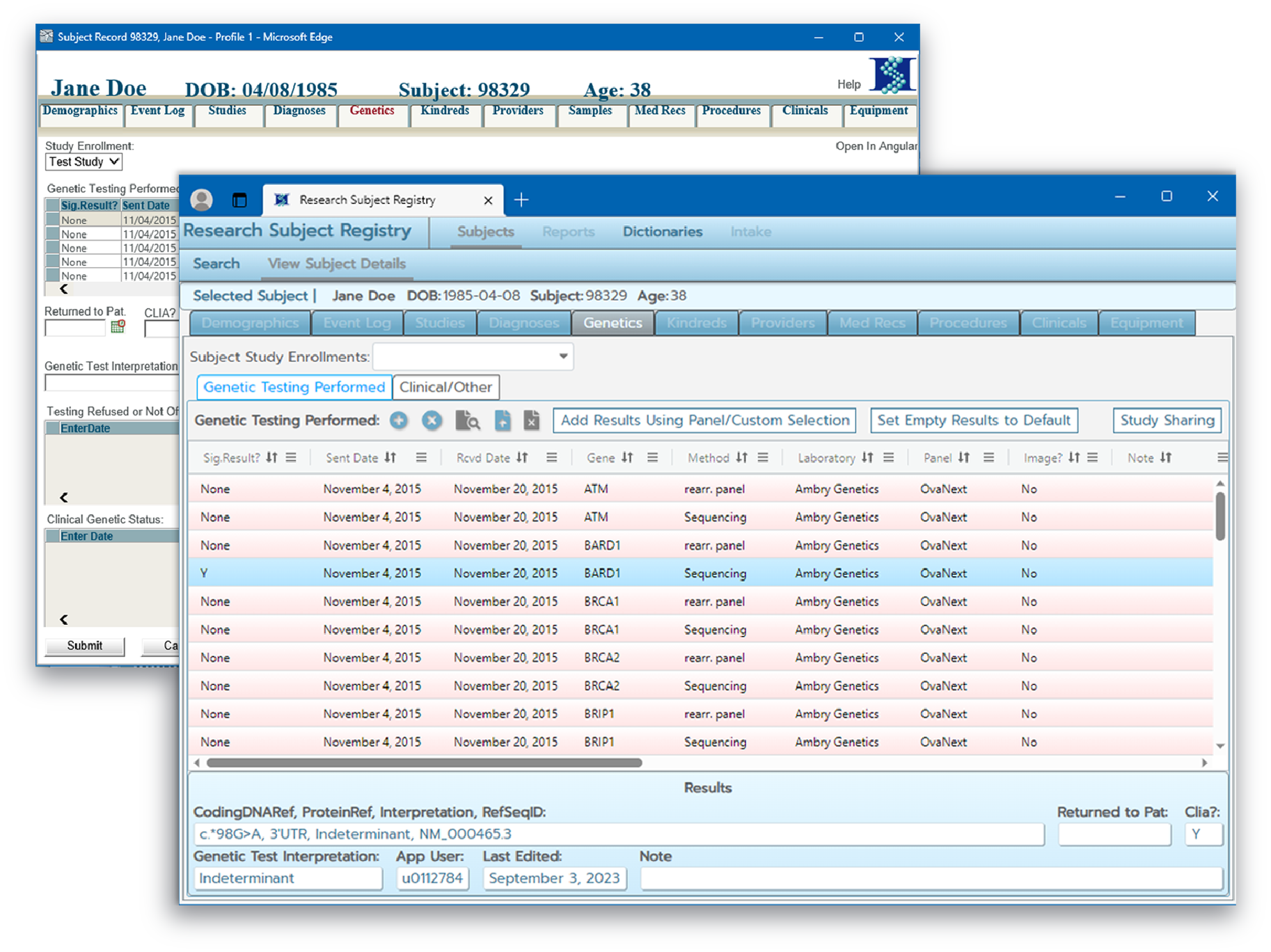
Research Subject Registry (RSR), developed by the Huntsman Cancer Institute's (HCI) Comprehensive Oncology Data & Engineering (CODE) Shared Resource, is available for population science research. It provides tracking all aspects of non-trial research study and project operation, including participant enrollment, questionnaires, classification, communication, follow-up, sample collection, family history, kindred relationships, genetic testing results, diagnoses, and medical records. RSR's flexible design supports a variety of project and disease types.
There are over 90 active research studies and more than 100,000 participants that are managed within RSR. Approximately one-third of those studies have regulatory approval to link to the Utah Population Database (UPDB). Based on this approval, RSR can automatically import kindred data, demographics, vital status, and diagnoses from UPDB.
HCI's Family Cancer Assessment Clinic (FCAC) provides clinical cancer genetic services to cancer patients and at-risk relatives. FCAC uses RSR to manage their clinical genetic testing workflow. Germline genetic testing data is imported quarterly from commercial laboratories. RSR allows collecting variant data in order to track reclassification of variants over time and testing among family members. The Inherited Cancer Research (ICR) Shared Resource also uses RSR for genetic research, and they have an established protocol to link genetic data to the UPDB.
Key Capabilities
CONFIGURATION Supports configuring study data on-the-fly through the HCI Configure-on-Demand (COD) interface.
INTEGRATION Imports kindred, demographic, vital status, and diagnosis data from UPDB with appropriate regulatory approval.
COLLABORATION Allows sharing participants between studies. With approval, supports research use of germline data tracked by the HCI Family Cancer Assessment Clinic.
REPORTING Researchers can report on all collected and linked data through iQ, including custom data.
SECURITY Study-level security allows researchers to assign roles to study users. In addition, where participants have consented to multiple studies, those studies can share participant information, including diagnoses, genetic test results, clinical genetic status, medical records, and procedures.
RSR Features
SEARCHING — Includes quick search, filtered search and cross-study search.
DEMOGRAPHICS — Includes name, birth, death, address, phone, race, ethnicity, height, weight, and identifiers (e.g. MRN, UPDB, UCR).
CONTENT MANAGEMENT — Includes event tracking, wizards for initial visits, consents, questionnaires, genetic tests, and samples. Provides automatic letter generation.
STUDY MANAGEMENT — Includes study enrollment, consents, questionnaires, medical record authorizations, providers, and provider roles.
DIAGNOSES — Includes cancers, cancer identifiers, and diagnoses.
GENETIC TESTS — Includes genetic tests and results, other tests, and clinical (phenotypic) genetic status.
FAMILY RELATIONSHIPS — Includes parents, children, siblings, kindreds, and kindred classifications. Provides ability to branch to other family member records.
MEDICAL RECORD MANAGEMENT — Includes authorizations, medical records, medical record identifiers, and procedures. Cancers and events are associated with the medical record, and samples are associated with procedures.
SAMPLES — Includes samples, sample identifiers, user defined sample results, and an interface to the CORE application for additional sample data.
QUERY — Researchers can report on their study data, including customized fields, through the iQ query tool.
REPORTING — Custom reports are available through the SSRS reporting tool. These reports can run daily, weekly, or monthly with availability sent to users' email boxes.
Interfaces
RSR is interfaced with UPDB, CORE for specimen tracking data, testing labs for germline results, REDCap for survey collection, and CCR to exchange data for specific projects.
Services Available
- Training
- Technical Support
- Application Configuration
- Application Development
- Query and Report Generation
- Natural Language Processing
CODE • Comprehensive Oncology Data & EngineeringCancer Center Shared Resource


